Engineered by Shenzhen Fuvin Led Technology Co., Ltd. for global B2B procurement across commercial, architectural, stage, and digital sign applications.

Understanding the fundamental physics, electromagnetic compatibility standards, and circuit topology required for long-lifecycle commercial LED tape installations.
In modern architectural, stage, and commercial lighting, the demand for continuous, hot-spot-free illumination has driven the shift toward high-density LED flexible strips and COB (Chip-on-Board) array architectures. Traditional low-density tapes (such as 30 or 60 LEDs/m) require deep aluminum channels and thick frosted diffusers to eliminate visible diode spotting. Conversely, high-density configurations utilizing 240 LEDs/m (SMD3014, SMD2835) or continuous COB encapsulations achieve seamless linear illumination even within ultra-slim 8mm to 10mm aluminum extrusions.
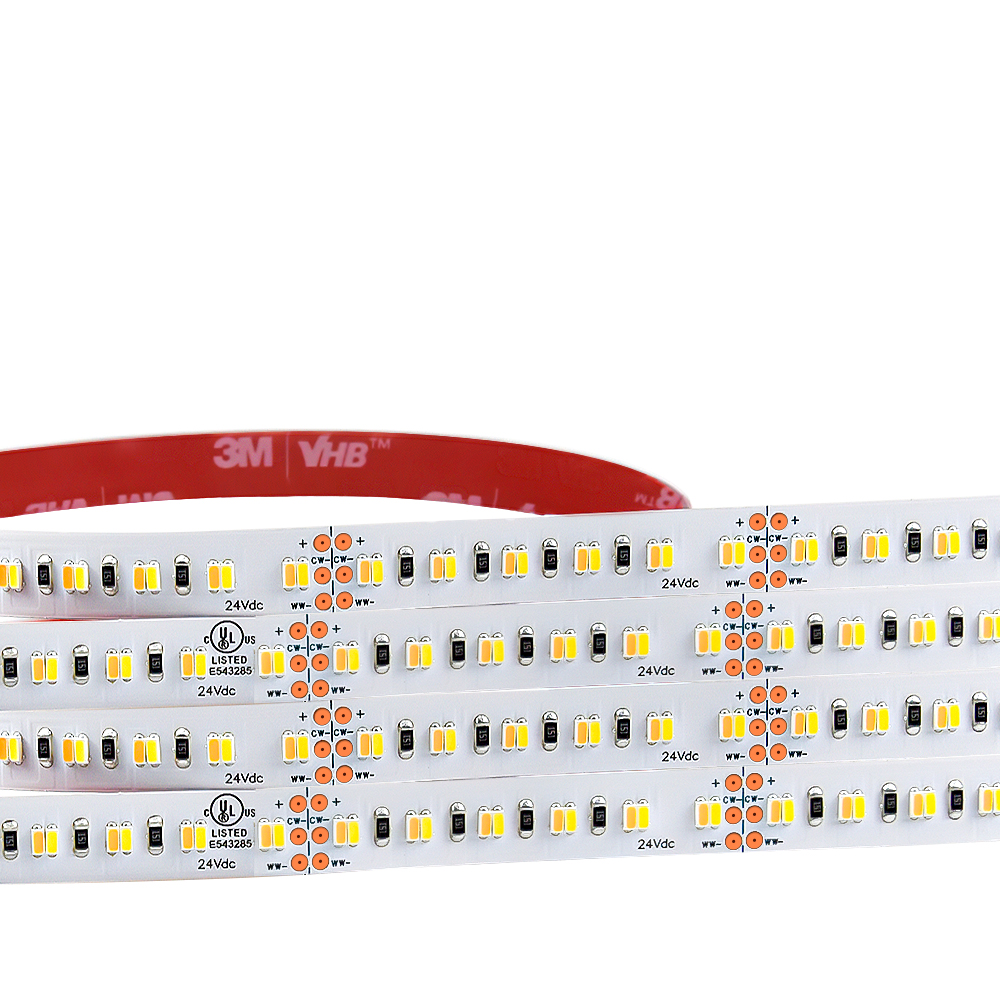
High diode packing density concentrates thermal energy within a narrow surface area. Qualified CE-certified suppliers employ 3oz/4oz double-sided rolled copper flexible printed circuits (FPC). High copper thickness minimizes longitudinal electrical resistance, suppresses voltage drop over 5m to 10m runs, and conducts heat away from LED junctions into the mounting substrate, maintaining lumen maintenance above L80B10 at 50,000 hours.
European market access demands compliance with the EMC Directive 2014/30/EU (EN 55015 / CISPR 15 for radio disturbance) and LVD Directive 2014/35/EU (EN 60598-2-21 for flexible LED strips). CE-compliant designs integrate onboard transient voltage suppressors (TVS), precision resistor networks, and decoupling capacitors per IC node to eliminate high-frequency switching noise and voltage spikes.
Commercial interior projects dictate strict color fidelity. High-density tunable white tapes (2700K to 6500K) utilize premium phosphor formulations yielding CRI (Ra) > 95, TLCI > 97, and R9 (saturated red) > 80 within a 3-step MacAdam ellipse, ensuring true-to-life skin tones and architectural material presentation without color shift during PWM dimming.
| Specification Parameter | Standard LED Strip (60 LEDs/m) | High-Density LED Strip (240 LEDs/m) | Continuous COB LED Strip |
|---|---|---|---|
| Diode Pitch & Uniformity | 16.6 mm pitch (Visible spotting) | 4.1 mm pitch (Spot-free in >15mm profiles) | Continuous phosphor (100% Dotless) |
| FPC Copper Thickness | 1oz / 2oz Single/Double Layer | 3oz / 4oz Heavy Double-Sided Rolled Copper | 3oz Double-Sided Rolled Copper |
| Thermal Resistance (θjs) | 35 - 45 °C/W | 18 - 25 °C/W (Efficient dissipation) | 15 - 20 °C/W (Direct chip die bonding) |
| Voltage Drop Tolerance | High drop over 5 meters (Requires injection) | Low drop (Integrated constant-current IC option) | Moderate drop (Requires double-ended power) |
| CE EMC / LVD Compliance | Basic resistor-limited circuit | Multi-stage RC filter & TVS diode protection | Integrated EMC filtering network |
Key engineering shifts shaping the next decade of architectural, stage, and commercial illumination.
Traditional pixel strips operating on 8-bit resolution yield 256 dimming steps per channel, causing noticeable stepping, stuttering, and flickering at low power levels (<5% output). Next-generation high-density pixel strips utilize driver ICs such as UCS8904 and UCS7604 offering 16-bit PWM resolution (65,536 dimming levels). This enables buttery-smooth fades, camera-ready flicker-free operation (>4000Hz refresh rate) essential for broadcast TV studios, theaters, and high-end hospitality projects.
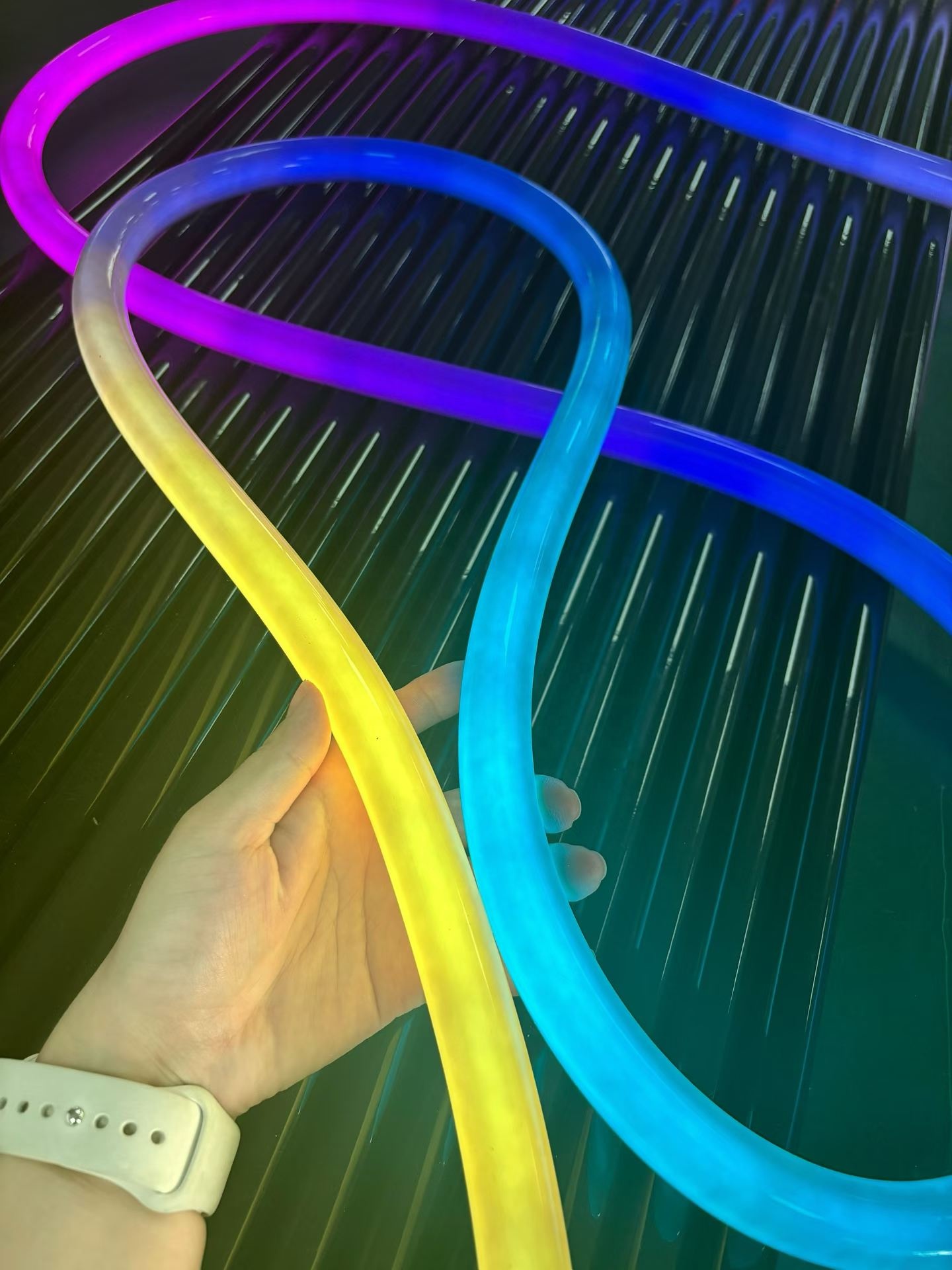
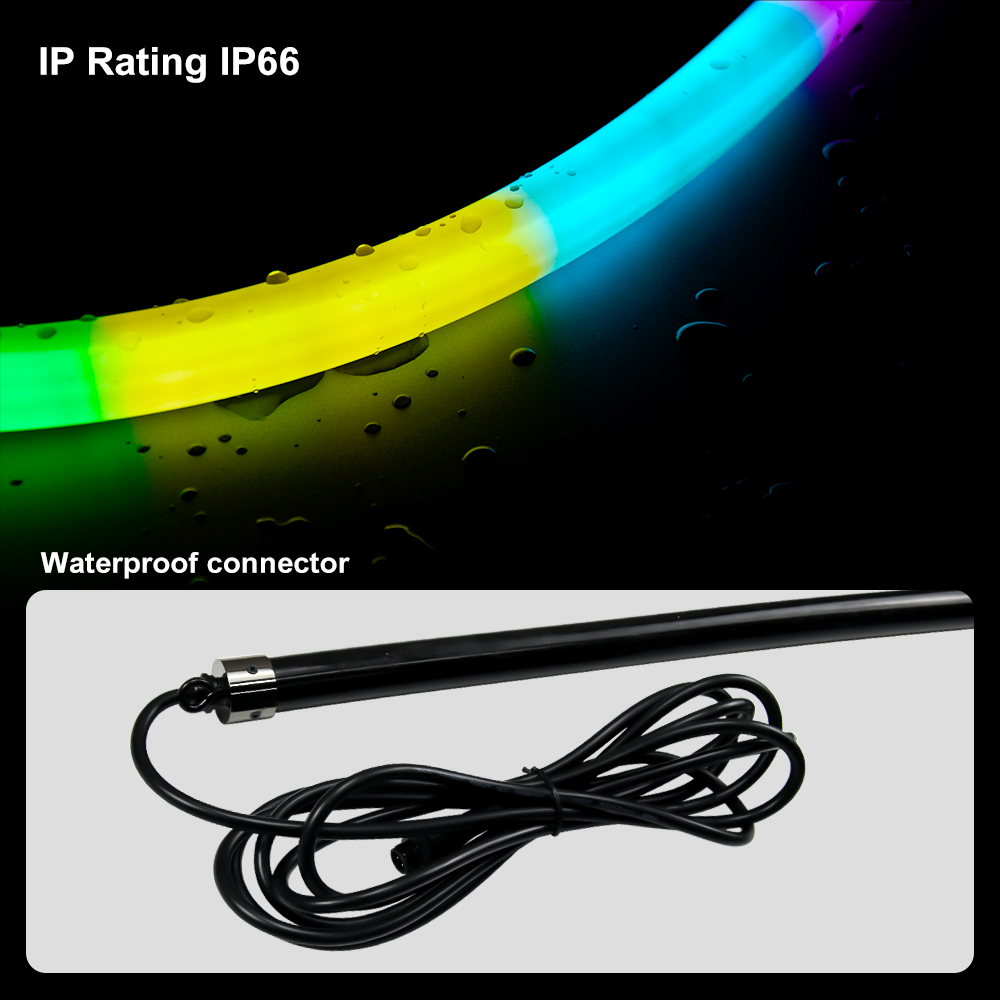
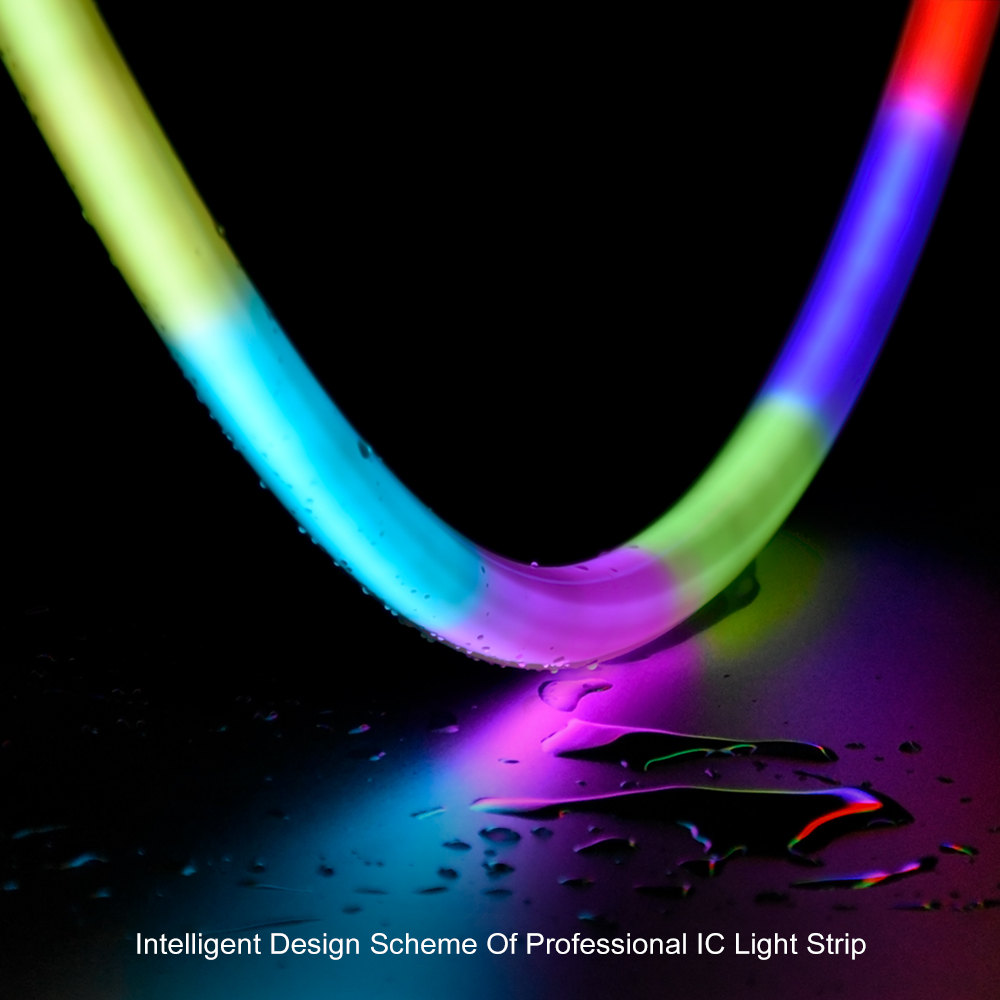
PVC-based neon flex is rapidly being phased out due to yellowing, micro-cracking under UV exposure, and environmental toxicity during disposal. Modern LED neon strips feature liquid silicone rubber (LSR) integrated co-extrusion with IP67/IP68 submersion ratings. Silicone offers extreme thermal stability (-40°C to +150°C), complete anti-UV resistance, salt-mist corrosion resistance for coastal projects, and superior flame retardancy (UL94-V0).
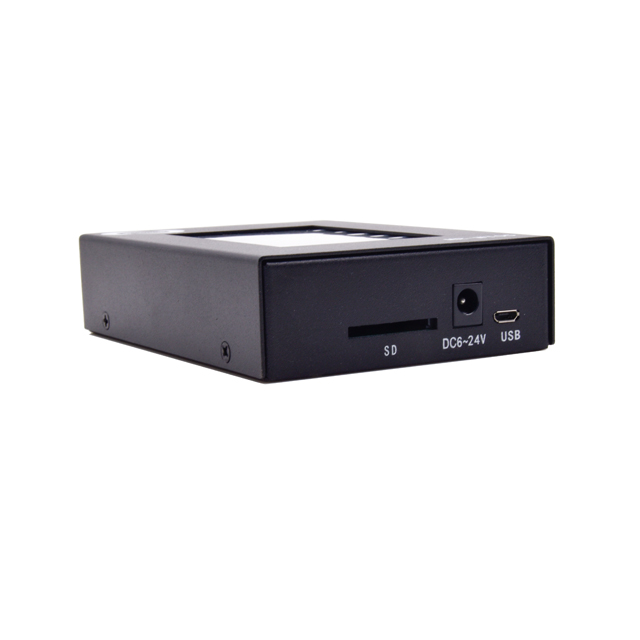
For large-scale building facades and entertainment venues, standard single-ended SPI signals suffer from attenuation over distance. The market is standardizing on RS-485 differential DMX512/RDM protocols (e.g., UCS512, TM512AC). Remote Device Management (RDM) allows handheld address writers (like the MR-WT35) to remotely assign DMX addresses, monitor operating temperature, and diagnose channel faults without physical access to high-elevation installations.
How wholesale distributors, system integrators, and OEM buyers can optimize total cost of ownership (TCO) and risk management.
Procurement of LED lighting products in 2025 and beyond is no longer governed solely by initial per-meter unit price. Global supply chain volatility, strict European ErP eco-design mandates, and escalating field-labor repair costs have refocused B2B buying criteria on verifiable factory compliance, modular serviceability, and system-level compatibility.
Leading importers require third-party onsite verification by international inspection bodies (such as SGS Group) to validate factory manufacturing capacity, automated SMT lines, and quality control protocols. Direct factory sourcing eliminates intermediary trading markups while guaranteeing access to original test reports (CE LVD, EMC, RoHS, and UL listed documents).
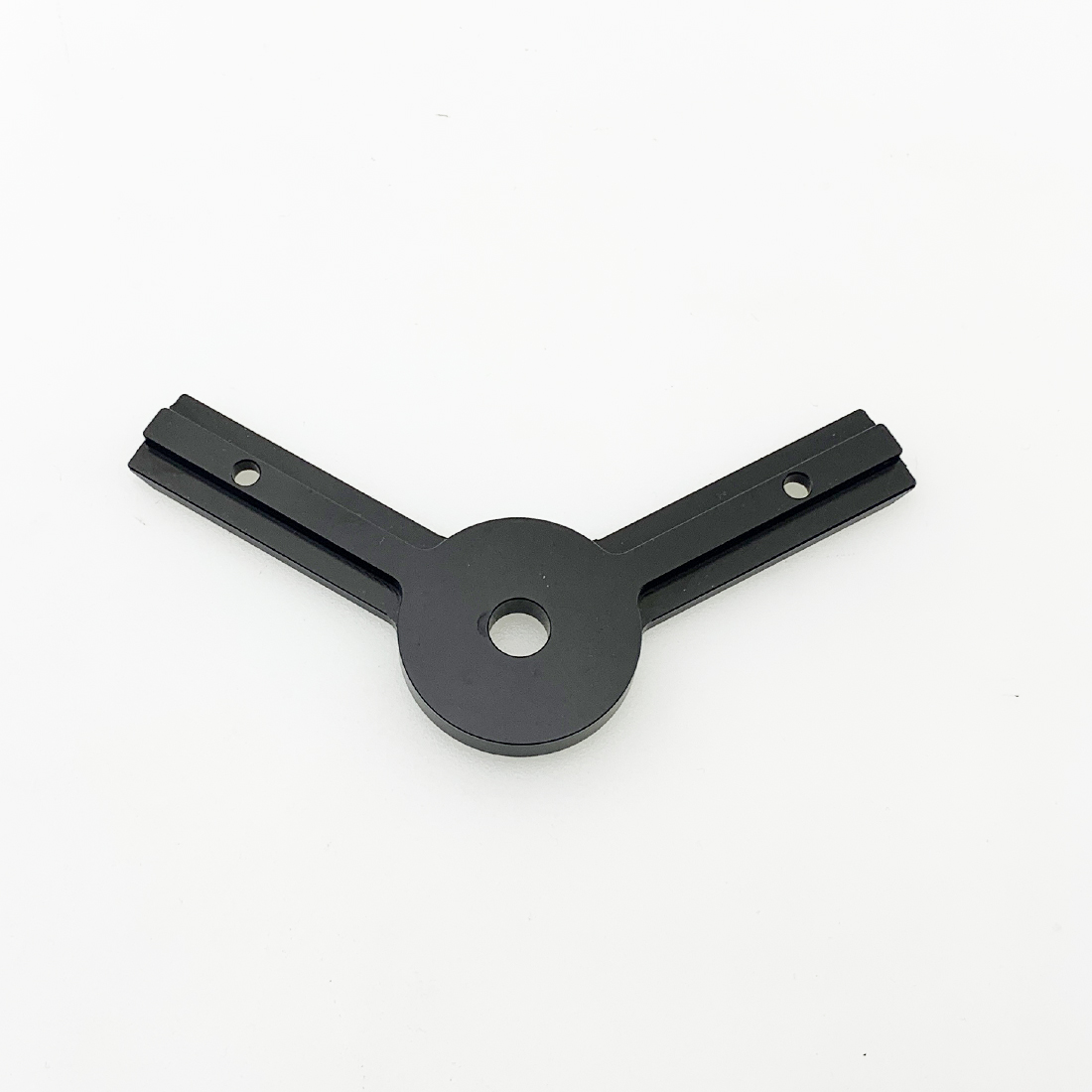
Procuring LED tapes in isolation frequently leads to field incompatibility with power drivers, controllers, or joiner connectors. Future-proof procurement mandates bundled ecosystem sourcing—pairing high-density strips directly with certified constant-voltage drivers, ArtNet/SPI pixel controllers, and specialized heavy-duty connectors (e.g., 120-degree V joiners for hexagon geometric arrays).
To reduce on-site installation labor costs in Western Europe and North America, buyers increasingly request factory pre-cut lengths, soldered IP68 injection-molded lead wires, customized PCB silkscreen branding, and private-label vacuum-sealed anti-static packaging ready for immediate retail or project deployment.
SGS-Verified Custom Manufacturer of Pixel & High Density Linear Lighting Solutions Since 2016.
Our manufacturing facility located in Shiyan, Shenzhen was audited onsite by SGS Group. We maintain strict compliance across automated SMT placement, ultrasonic silicone extrusion, vacuum sealing, and high-temperature powered aging tests.
We provide full-scope customization: tailored FPC width (5mm to 20mm), custom LED density (up to 480 LEDs/m), specialized IC integration (UCS2904, UCS8904, DMX512), voltage configuration (5V/12V/24V), and custom IP rating extrusion.
Our product lines carry full CE EMC, CE LVD, RoHS compliance test reports, Declaration of Conformity (DoC), and selected strip models feature UL and cUL listings for frictionless clearance in European and North American markets.
We serve system integrators, lighting designers, and wholesale importers across Western Europe, North America, Oceania, and the Middle East with a 99.31% fast response rate and 4.9/5 buyer rating.
Essential technical and commercial answers for LED strip importers, engineers, and buyers.
CE EMC (Electro-Magnetic Compatibility under Directive 2014/30/EU) ensures that the LED strip and its control circuitry do not emit radio frequency interference that disrupts neighboring electronic devices, while also resisting external electromagnetic noise. CE LVD (Low Voltage Directive 2014/35/EU, specifically EN 60598-2-21) certifies electrical safety, insulation resistance, flame retardancy, and protection against electric shock for flexible lighting arrays operating between 50V AC and 1000V AC or 75V DC and 1500V DC.
Copper thickness directly determines the FPC's cross-sectional trace area. A 1oz copper FPC experiences significant electrical resistance, leading to severe voltage drop (dimming towards the end of a 5-meter strip) and high operational temperatures. A heavy 3oz or 4oz double-sided rolled copper FPC reduces electrical resistance by over 60%, maintaining uniform brightness from power injection to the reel's end while acting as a continuous thermal heat-sink to protect diode junction temperatures.
UCS2904 operates on 8-bit color depth (256 grayscale levels per channel), which is ideal for standard architectural color washing and sign lighting. UCS8904 provides 16-bit true grayscale resolution (65,536 levels per channel). This 256-fold increase in control precision eliminates visible stepped transitions during low-brightness dimming (<1%), delivering broadcast-grade, camera-flicker-free performance required for live TV stages, theaters, and luxury retail installations.
Silicone co-extrusion fuses liquid silicone directly around the LED FPC in a single continuous high-temperature process, leaving zero air gaps for moisture condensation or capillary water ingress. Hollow silicone sleeves or PVC tubes can trap air and moisture, leading to internal oxidation, yellowing under UV radiation, and cracking in freezing ambient temperatures (-40°C). Co-extruded silicone provides absolute IP67/IP68 sealing, UV resistance, and superior thermal conductivity.
Yes. As an SGS-verified custom manufacturer, we offer full OEM/ODM engineering services. We can design custom PCB widths (slim 5mm up to 20mm), alter diode spacing, integrate specified driver ICs (UCS2904, UCS8904, SK6812, WS2814, DMX512), pre-cut strips to exact millimeter dimensions, add waterproof quick-connectors, and print buyer brand logos directly on the FPC and reels.
Every production batch undergoes a 12-step quality control workflow: incoming raw material inspection (diodes, copper FPC, ICs), 100% automated optical inspection (AOI) post-SMT welding, continuous 100% powered 8-hour high-temperature aging test, electrical multimeter continuity checks, IP68 submersion pressure testing (for waterproof models), and moisture-proof vacuum-sealed anti-static packaging before export.
 Shenzhen, Guangdong, China